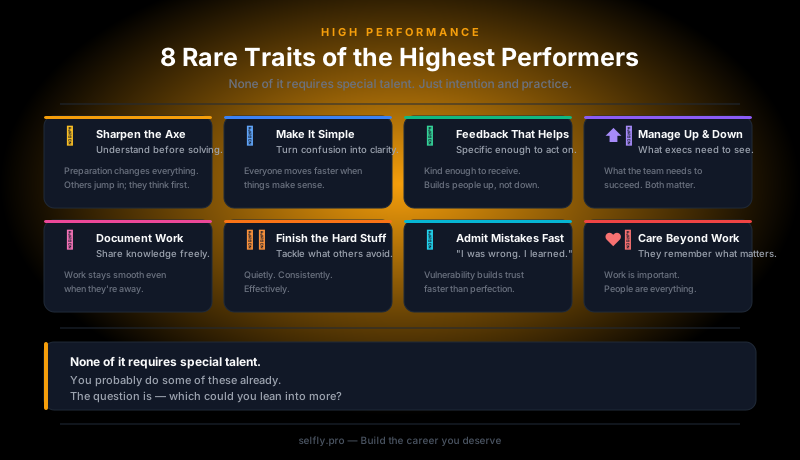
After working with hundreds of senior professionals, certain patterns keep showing up. The highest performers aren't always the most technically gifted or the most experienced in the room. But they consistently share these 8 traits.
1. They 'Sharpen Their Axe' First
They take time to understand before jumping to solve. That extra preparation upfront changes everything.
What this looks like
While others are already deep into execution, high performers are still asking questions. They read the brief twice. They map the problem before writing a single line of code or a single slide. The result? Fewer wrong turns, faster delivery, and solutions that actually fit.
2. They Make Complex Things Simple
They turn confusion into clarity. Everyone moves faster when things make sense.
Complexity is easy. Simplicity is a skill. The highest performers can take a tangled problem, a messy situation, or a dense strategy document and explain it in a way that immediately makes sense to everyone in the room — from the intern to the CEO.
3. They Give Feedback That Actually Helps
Their feedback builds people up. Specific enough to act on. Kind enough to receive.
- They focus on the work, not the person
- They give one or two specific things to improve — not a list of everything wrong
- They acknowledge what worked before addressing what didn't
- They follow up to see if the feedback landed and helped
4. They Manage Up and Down Equally Well
They know what executives need to see — and what their team needs to succeed.
This is one of the rarest skills in organisations. Most people are naturally stronger in one direction. High performers are fluent in both. They translate strategy into execution for their teams, and translate execution into strategy for leadership. They reduce friction at every level.
5. They Document Their Work
They share knowledge freely. Their work stays smooth even if they're away.
Why this matters
Undocumented work creates single points of failure. High performers write things down not because they're told to, but because they understand that knowledge trapped in one person's head is fragile. It also signals confidence — they're not protecting their position by hoarding information.
6. They Finish the Hard Stuff
They tackle what others avoid. Quietly. Consistently. Effectively.
Every organisation has a pile of things that nobody wants to touch — the legacy system, the difficult stakeholder, the unclear brief, the project that's been restarted three times. High performers don't wait to be assigned these things. They pick them up. And they see them through.
7. They Admit Mistakes Quickly
"I was wrong. Here's what I learned." Vulnerability builds trust faster than perfection.
There's a common assumption that admitting mistakes makes you look weak. The opposite is true. When a high performer says "I got that wrong — here's what happened and here's what I'm doing differently" it signals maturity, self-awareness, and the kind of honesty that makes teams function better.
What to do
The faster you own a mistake, the smaller it stays. The longer you defend it, the bigger it gets.
8. They Care About People Beyond the Work
They remember what matters to you. Work is important. People are everything.
They ask how the weekend went — and they actually listen to the answer. They remember that someone's parent was in hospital. They notice when a teammate is quieter than usual. This isn't a performance. It's a genuine orientation toward people that makes everyone around them feel seen and supported.
The bottom line
Here's what stands out about this list: none of it requires special talent. No elite education, no rare skill set, no unfair advantage. Just intention and consistent practice. You probably already do some of these. The question worth asking is: which one could you lean into more?